
GPO vs Distributor vs Buying Group vs Direct Contracting: Which Model Saves More?
AI Summary
Long-term and senior care facilities can source supplies through a group purchasing organization (GPO), a distributor relationship, an independent buying group, or direct vendor contracting. Each model offers a different balance of savings, control, and administrative burden, and the right choice depends on facility size, purchasing volume, and internal resources. Facility leaders often assume there is one correct way to purchase supplies, but four distinct models exist to fit different operational realities. Choosing the wrong model can increase costs and add administrative work that pulls staff away from resident care.
What Each Model Does
1. Group Purchasing Organization: A Group Purchasing Organization(GPO) aggregates purchasing volume across many facilities to negotiate lower prices with vendors, funded through administrative fees paid by vendors, typically structured near 3 percent of purchase price under federal safe harbor rules.
2. Distributor Relationship: A facility contracts directly with a single distributor, such as a food service or medical supply company, receiving pricing based on that distributor’s own scale rather than a pooled group.
3. Independent Buying Group: Smaller than a national GPO, a buying group pools purchasing power among a limited network of facilities, often within a region or ownership group.
4. Direct Contracting: A facility negotiates directly with manufacturers or suppliers without an intermediary, retaining full control over terms but losing the negotiating leverage a larger group provides.
Comparing Savings Potential
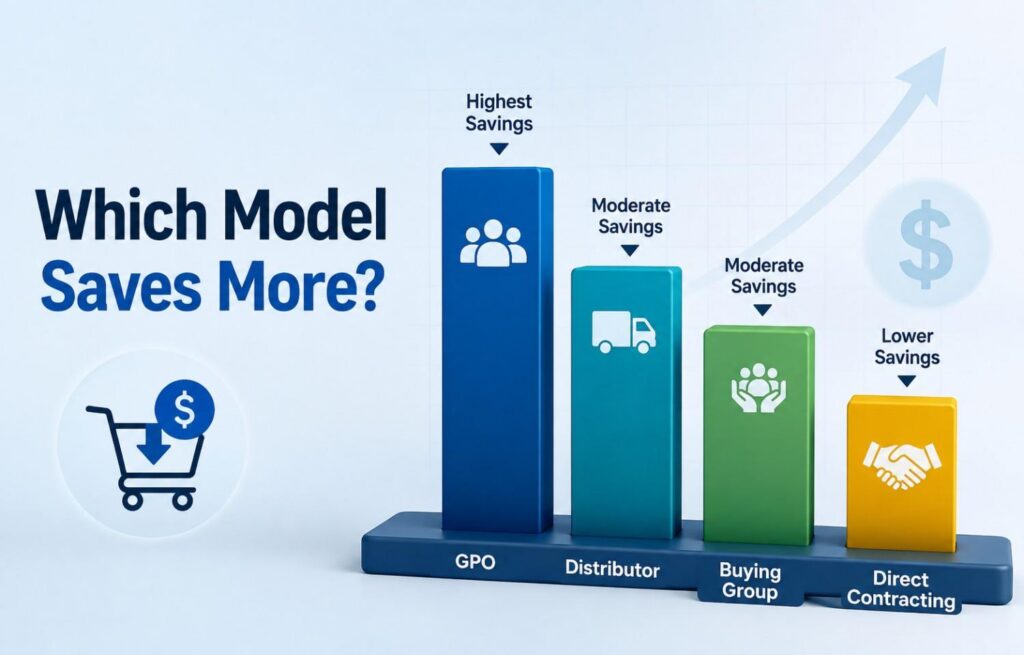
| Model | Typical Savings Driver | Administrative Burden | Best Fit |
|---|---|---|---|
| GPO | Pooled volume across many facilities | Low, GPO manages vendor relationships | Multi-site or mid to large facilities |
| Distributor | Single-vendor scale pricing | Moderate, facility manages one relationship | Facilities with strong existing distributor ties |
| Buying Group | Pooled volume within a smaller network | Moderate, shared governance among members | Regional operators with aligned needs |
| Direct Contracting | Facility-specific negotiation | High, facility manages every vendor separately | Large operators with dedicated procurement staff |
How Much Can Each Purchasing Model Actually Save?
| Model | Main Savings Driver | Factors Affecting Actual Savings |
|---|---|---|
| GPO | Pooled purchasing volume | Contract compliance, vendor coverage, facility spend |
| Distributor | Supplier scale and volume pricing | Markups, freight, product selection |
| Buying Group | Shared purchasing power | Group size, vendor participation |
| Direct Contracting | Facility-specific negotiation | Purchase volume, negotiation expertise |
Cover these points:
- Savings vary by facility size, purchasing volume, and category.
- The lowest unit price does not always mean the lowest total cost.
- Administrative workload, freight, contract compliance, and vendor management should also be considered.
- Facilities should compare their actual current spend against available purchasing options.
Where GPOs Typically Outperform
A GPO usually delivers the strongest combination of savings and reduced administrative load because it pools purchasing volume across many facilities while also managing vendor relationships, contract compliance, and rebate tracking on the facility’s behalf.
For senior care operators with limited procurement staff, this reduces the burden of managing dozens of individual vendor contracts.
Where Distributor Or Direct Models Make Sense
Some facilities already have strong pricing through a single distributor, particularly in food service, where regional scale can rival GPO pricing. Direct contracting fits large operators with dedicated purchasing teams who prefer full control over supplier terms, even at the cost of losing pooled negotiating leverage.
Factors That Determine The Right Fit
1. Facility size and purchase volume: Smaller single-site facilities generally see more value from a GPO than from direct contracting since they lack the volume to negotiate favorable terms alone.
2. Internal procurement staffing: Facilities without dedicated purchasing staff benefit from a model that shifts vendor management workload elsewhere.
3. Category-specific needs: A facility may use a GPO for medical and nursing supplies while relying on a direct distributor relationship for dietary categories, blending models rather than choosing one exclusively.
4. Compliance requirements: Any model involving administrative fees paid by vendors must operate within Anti-Kickback Statute safe harbor requirements, which is a structural safeguard built into properly run GPOs.
Why the Lowest Unit Price Isn’t Always the Lowest Cost
| Factor | Question to Ask |
|---|---|
| Facility Size | How much purchasing volume do we control? |
| Procurement Staff | How much time can our team spend managing vendors? |
| Current Pricing | Are our existing contracts competitive? |
| Vendor Flexibility | Do we need multiple suppliers or specialized products? |
| Supply Reliability | Can the model provide consistent product availability? |
| Contract Compliance | Can staff consistently purchase through contracted vendors? |
| Total Cost | What is the real cost after freight, administration, and other expenses? |
Cover these points:
- Start with an analysis of current purchasing spend.
- Identify the categories with the largest expenses.
- Compare current vendor pricing against GPO, distributor, buying group, and direct options.
- Consider both financial savings and administrative workload.
- Evaluate vendor flexibility and supply reliability.
- Review contract compliance before making a final decision.
- Choose the model that provides the strongest overall value, rather than simply the lowest quoted price.
Choosing The Right Purchasing Model
There is no universally superior model. The right choice depends on matching purchasing structure to facility size, staffing, and category needs rather than defaulting to whichever model a sales representative pitched most recently.
Compare Your Options With An Expense Expert
Facility leaders evaluating GPO, distributor, buying group, or direct contracting options do not need to guess which model fits best.
Prime Source Expense Experts evaluates and compares purchasing models against your facility’s actual spend data. Request a free spend analysis to see which structure delivers the strongest return for your operation.
Frequently Asked Questions
1. Is a GPO always cheaper than direct contracting?
Not always, since direct contracting can work well for large operators with dedicated procurement teams, though most single-site and mid-size facilities see better results through a GPO’s pooled purchasing power.
2. Can a facility use more than one purchasing model at the same time?
Yes, many facilities blend a GPO for medical and nursing categories with a direct distributor relationship for food service or other specialized needs.
3. What is the main difference between a GPO and a buying group?
A GPO typically operates at a larger, often national scale, while a buying group pools volume among a smaller regional network of facilities.
4. Does using a GPO limit a facility’s vendor choices?
It depends on the specific GPO contract, since some allow flexibility to keep existing vendors while others require use of GPO-contracted suppliers.
5. How does administrative fee structure differ across these models?
GPOs collect fees from vendors under safe harbor rules, typically near 3 percent of the purchase price, while distributor and direct models generally do not involve this type of fee structure at all.

Michael is an accomplished leader with deep expertise in the healthcare sector. As the CEO of Prime Source, he has driven innovation and strategic growth in healthcare procurement and management. His extensive knowledge of the industry has made him a sought-after speaker, regularly lecturing at trade groups, seminars, and to industry executives on the most pressing healthcare trends and challenges. Michael is passionate about exploring the intersection of business and healthcare, providing thought leadership that shapes the future of the field.