
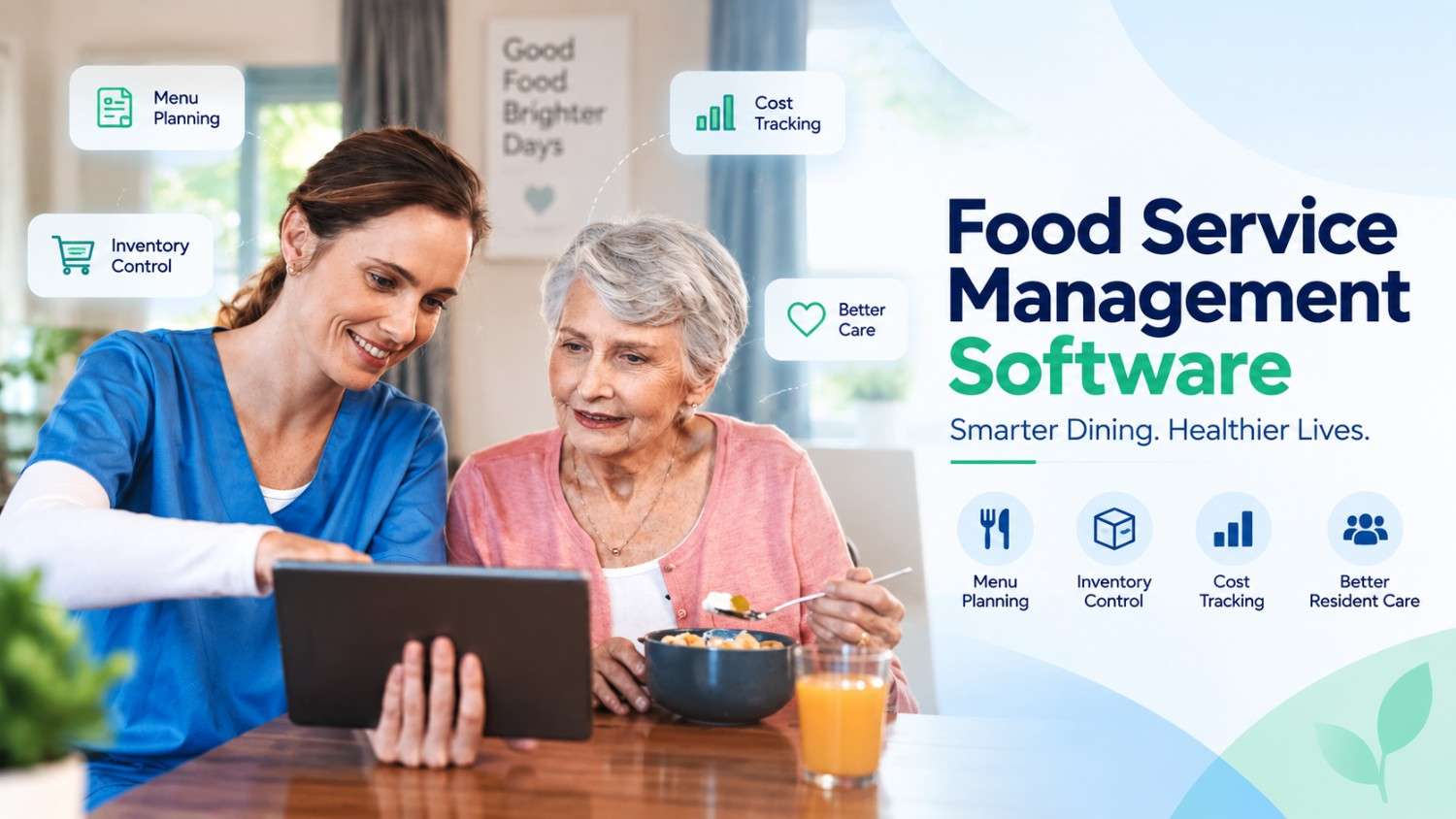
Best Food Service Management Software for Nursing Homes & Senior Living: 2026 Buyer’s Guide
AI Summary
Food service management software helps nursing homes and senior living communities control costs, streamline inventory, manage menus, monitor suppliers, reduce waste, and improve reporting. In 2026, the right platform should also support dietary flexibility, resident preferences, purchasing strategy, and system integration.
Food service is one of the most visible and operationally complex parts of a nursing home or senior living community. It affects resident satisfaction, nutrition, staffing, inventory, purchasing, waste, and the facility’s bottom line.
In 2026, those responsibilities are becoming more demanding. Senior living operators are responding to greater demand for dietary flexibility, more menu variety, global flavors, personalized diets, and restaurant-style dining experiences.
At the same time, operators still need to control food costs and manage purchasing efficiently.
That is where food service management software can make a difference. The right platform can connect menu planning, recipes, inventory, purchasing, food costs, supplier management, and reporting in one system.
But not every food service platform is designed for nursing homes and senior living. This buyer’s guide explains what operators should look for in 2026 and how to evaluate software based on operational and financial needs.
Related Reading: Fall 2026 Long-Term Care Conferences: The Complete Exhibitor & Attendee Guide (IHCA, OHCA, CHCA, PALA, eCapWest & More)
Why Senior Living Operators Need Better Food Service Technology in 2026
Senior living dining expectations continue to evolve.
Residents increasingly want more choice, variety, personalized diets, and flavors that reflect changing preferences. Recent 2026 industry coverage highlights growing demand for global cuisines, bold flavors, gluten-free and vegan options, and more flexible dining experiences.
That creates an operational challenge.
More choices can mean more ingredients, more SKUs, more inventory decisions, and greater potential for food waste.
Without accurate data, dining directors may struggle to answer basic questions:
- What does each menu item actually cost?
- Which ingredients are driving food costs?
- How much inventory is currently on hand?
- Where is food being wasted?
- Are supplier prices changing?
- Which meals are most popular?
- Which products should be reordered?
- Are purchasing decisions aligned with the budget?
The right software should make these answers easier to find.
7 Features to Look for in Food Service Management Software
1. Real-Time Food Cost Tracking
Food costs can change as ingredient prices change. A menu item that was profitable months ago may cost very differently today.
Look for software that allows operators to track ingredient and recipe costs in real time.
This gives dining teams better visibility into the actual cost of meals and helps them make informed decisions when prices increase.
The goal is not simply to lower food costs. It is to understand them well enough to protect quality while managing the budget.
2. Automated Inventory Management
Inventory is one of the areas where food service teams can quickly lose visibility.
Excess inventory ties up capital and can increase spoilage and waste. Insufficient inventory can lead to emergency purchasing and operational disruptions.
Food service software should provide a clear view of:
- Current inventory
- Ingredient usage
- Purchase history
- Reorder requirements
- Product costs
- Waste
- Inventory trends
Our automated inventory control helps facilities manage stock shortages and excess waste.
3. Menu and Recipe Management
Menu planning should connect directly to cost and operational data.
A strong platform should help dining teams manage recipes, calculate ingredient costs, evaluate menus, and make adjustments without relying on disconnected spreadsheets.
This becomes particularly important as residents request greater variety and more personalized dietary options.
Instead of simply asking, “What should we serve?”, operators can also ask:
What should we serve that meets resident needs and makes financial sense?
That is a much more useful procurement and menu-planning decision.
4. Supplier and Purchasing Management
The software should make it easier to understand where food is being purchased and at what price.
Supplier management capabilities can help operators monitor:
- Vendor pricing
- Contract terms
- Purchase history
- Product availability
- Supplier performance
- Purchasing patterns
This information can support better negotiations and help identify opportunities to consolidate purchasing.
Our nutritional optimization approach combines industry insights, supplier partnerships, purchasing analysis, and GPO access to help post-acute, long-term care, and assisted living facilities improve purchasing decisions.
This is an important distinction: technology should support procurement strategy rather than operate separately from it.
5. Waste and Cost Visibility
Food waste is both an operational and financial issue.
If a facility regularly purchases ingredients it doesn’t fully use, the impact can accumulate over weeks and months.
Software should help teams identify where waste occurs and connect that information to purchasing and menu decisions.
For example, if a particular ingredient is frequently left unused, the facility may need to reconsider:
- Order quantities
- Menu frequency
- Portion planning
- Storage practices
- Product substitutions
The objective is to turn waste data into an operational improvement.
6. Reporting and Analytics
A good food service system should make information easier to act on.
Useful reports can include:
- Food cost by meal or recipe
- Inventory trends
- Purchasing spend
- Vendor costs
- Waste
- Menu performance
- Budget variance
- Ingredient usage
Prime Source emphasizes data-driven decision-making and integrated reporting as part of its food service management software approach.
For facility operators, this means moving from assumptions to measurable information.
7. Integration and Ease of Use
Food service teams are already managing demanding daily operations. Software that adds complexity will not solve the problem.
Look for systems that are easy to implement, provide training and support, and can integrate with existing POS, accounting, and operational systems.
Prime Source states that its food service software is designed for ease of implementation and can integrate with existing POS, accounting, and other operational systems.
Related Reading: Why Do Nursing Homes Smell Weird? And What It Reveals About Facility Operations
How to Compare Food Service Software
When evaluating solutions, facility operators should look beyond the number of features.
Consider five questions:
Does it improve visibility?
Can managers clearly see food costs, inventory, purchasing, and waste?
Does it support cost control?
Can the system identify changes in ingredient costs and purchasing patterns?
Does it improve efficiency?
Will it reduce manual work rather than create another administrative burden?
Does it support resident needs?
Can dining teams manage changing preferences and dietary requirements effectively?
Does it connect with purchasing strategy?
Can the technology work alongside supplier relationships, contracts, and GPO purchasing?
The best software should support both the dining operation and the financial goals of the facility.
Related Reading: 15 Questions to Ask a GPO Before You Sign (2026 Buyer’s Checklist)
Software Alone Is Not the Whole Solution
Technology is valuable, but software should not be viewed as a replacement for sound purchasing strategy.
A facility can have excellent data and still overspend if it lacks purchasing discipline, supplier management, contract oversight, or standardized processes.
That is why Prime Source approaches food service through a combination of analysis, membership, and optimization. Its dietary and nutrition solution is designed to analyze current expenses, provide access to supplier contracts, and compare operations against industry benchmarks to identify opportunities for improvement.
This broader approach matters because food service costs are influenced by more than the software platform itself.
The Prime Source Approach to Food Service Management
Prime Source Expense Experts positions its food service management software as part of a broader expense-management and purchasing strategy.
The platform provides visibility into food costs, inventory, suppliers, forecasting, menu decisions, and reporting. That technology can be paired with Prime Source’s purchasing network and nutritional optimization services.
Prime Source also works with major foodservice suppliers, including Sysco, Gordon Food Service, US Foods, Performance Food Service, Bimbo, and Dairy Farmers of America.
For nursing care management, homes and senior living operators, the objective is straightforward: improve food service operations while controlling costs and protecting resident experience.
Final Takeaway
The best food service management software for nursing homes and senior living is not necessarily the platform with the longest feature list. It is the solution that gives operators better visibility, improves purchasing decisions, reduces manual work, controls food costs, and supports a higher-quality dining experience.
In 2026, resident expectations are changing while operators continue to manage financial pressure. That makes connected food service technology increasingly valuable.
For facilities evaluating their options, start with the fundamentals: cost tracking, inventory management, menu and recipe control, supplier management, waste visibility, analytics, and integration. Then evaluate whether the solution can support the larger purchasing and expense-management strategy.
Prime Source Expense Experts takes this approach beyond software alone. Its Food Service Management Software, nutritional optimization services, supplier network, and purchasing expertise are designed to help long-term care and senior living facilities improve operations while building a more sustainable food service program.
Frequently Asked Questions
1. What is food service management software for nursing homes?
It is software designed to help senior living and nursing home operators manage food costs, inventory, recipes, menus, purchasing, suppliers, waste, and reporting from one centralized platform.
2. What features should senior living food service software include?
Key features include real-time food cost tracking, automated inventory management, menu and recipe management, supplier and purchasing management, waste tracking, reporting and analytics, and integration with existing operational systems.
3. How can food service software reduce costs?
It provides visibility into ingredient prices, purchasing patterns, inventory levels, waste, and menu costs. This information helps dining teams make better purchasing decisions, identify inefficiencies, reduce excess inventory, and control food spending.
4. Can food service software support dietary and resident preferences?
Yes. The right system can help dining teams manage menus, recipes, dietary requirements, and greater variety while connecting these decisions with ingredient costs and purchasing data.
5. Is food service software enough to optimize dining expenses?
Not by itself. Software provides valuable data and operational visibility, but effective cost control also requires purchasing discipline, supplier management, contract oversight, and a broader expense-management strategy.

Michael is an accomplished leader with deep expertise in the healthcare sector. As the CEO of Prime Source, he has driven innovation and strategic growth in healthcare procurement and management. His extensive knowledge of the industry has made him a sought-after speaker, regularly lecturing at trade groups, seminars, and to industry executives on the most pressing healthcare trends and challenges. Michael is passionate about exploring the intersection of business and healthcare, providing thought leadership that shapes the future of the field.