
GPO Safe Harbor Explained: What the 3% Admin Fee Rule Means for Your Facility
AI Summary
The GPO safe harbor is a federal regulation that protects group purchasing organizations and their administrative fees from being classified as illegal kickbacks under the Anti-Kickback Statute. The rule commonly requires fees to stay at or below 3 percent of the purchase price or requires the contract to disclose the exact or maximum fee charged. Understanding the safe harbor and the 3 percent figure helps healthcare facility executives evaluate whether a GPO purchasing agreement is properly structured, compliant, and based on a reasonable fee arrangement.
What The Anti-Kickback Statute Prohibits
The federal Anti-Kickback Statute makes it illegal to knowingly offer, pay, solicit, or receive payment intended to induce referrals or purchases involving federal healthcare programs.
Because GPOs receive administrative fees from vendors in exchange for facilitating purchasing volume, this arrangement could technically fall under that prohibition without a specific exception.
How The Safe Harbor Protects GPO Arrangements
Congress created a statutory exception for Group Purchasing Organization(GPO) administrative fees, and the Department of Health and Human Services Office of Inspector General later established the regulatory safe harbor at 42 CFR 1001.952 that defines exactly how a GPO arrangement must be structured to qualify for protection.
To fall within the safe harbor, a GPO arrangement generally must include:
- A written agreement between the GPO and each participating facility.
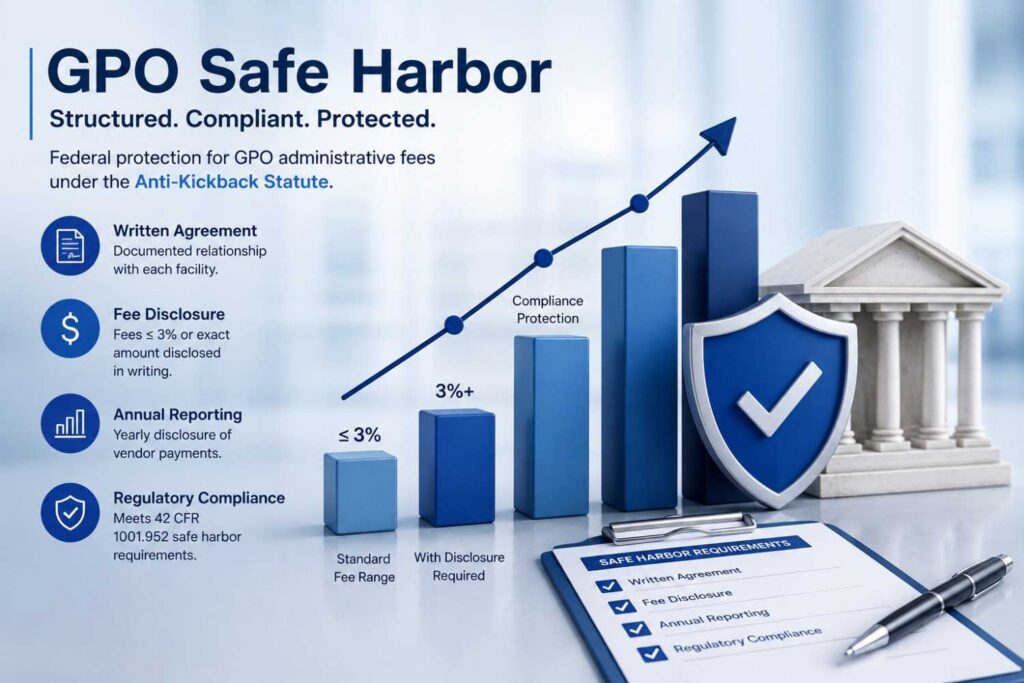
- A fee structure disclosed in writing, specifying either that the administrative fee will not exceed 3 percent of the purchase price, or stating the exact amount or maximum amount the vendor will pay if it exceeds that threshold.
- Annual disclosure to each facility member, and to the Secretary of Health and Human Services upon request, detailing the amount received from each vendor on that facility’s behalf.
What the GPO Safe Harbor Does Not Protect
| Point | What to Explain |
|---|---|
| Safe harbor is not blanket immunity | Meeting the safe-harbor requirements provides protection only for arrangements that satisfy the applicable conditions. |
| 3% is not a universal fee cap | Fees above 3% can still qualify if the written agreement specifies the amount or maximum amount. |
| Arrangement must fit the GPO definition | The safe harbor applies to qualifying GPO arrangements involving vendors and entities furnishing services reimbursed by Medicare or a State healthcare program. |
| Other conduct can create risk | A purchasing arrangement should not be assumed compliant simply because it involves a GPO or contains a fee disclosure. |
Key points to add:
- A safe harbor provides protection when all applicable conditions are satisfied; it is not a blanket approval of every GPO arrangement.
- The 3% figure is not a hard legal ceiling on every GPO administrative fee. The regulation provides an alternative disclosure requirement when the fee is not fixed at 3% or less.
- The arrangement must meet the regulatory definition and requirements applicable to GPOs.
- If an arrangement falls outside the safe harbor, that does not automatically mean it violates the Anti-Kickback Statute. It means the arrangement does not receive the safe harbor’s protection and may require case-by-case analysis.
- This distinction is important because your current article correctly makes this point in an FAQ, but it deserves to be explained in the main content.
Why The 3 Percent Threshold Exists
GPO Safe Harbor Explained
The 3 percent figure is not an arbitrary number.
It represents the threshold below which an administrative fee does not require additional written disclosure of the exact amount, since regulators consider fees at or below this level unlikely to create the kind of financial incentive the Anti-Kickback Statute was designed to prevent.
Fees above 3 percent are not automatically illegal, but they do require the contract to state the specific or maximum fee amount in writing.
| Safe Harbor Requirement | What It Means For Your Facility |
|---|---|
| Written agreement | Your GPO relationship must be documented, not informal |
| Fee disclosure | Fees above 3 percent must be explicitly stated in the contract |
| Annual reporting | Your facility should receive a yearly statement of vendor payments |
| Regulatory citation | The arrangement should reference 42 CFR 1001.952 compliance |
What This Means For Long-Term And Senior Care Facilities
Facilities operating under Medicare and Medicaid certification have a direct interest in ensuring their GPO relationships are properly structured.
An improperly structured arrangement does not just create legal risk for the GPO; it can expose the facility to scrutiny during audits or investigations tied to federal healthcare program participation.
When reviewing a GPO contract, facility leaders should confirm the agreement explicitly references safe harbor compliance, includes clear fee disclosure, and commits to annual reporting. These are not optional formalities.
They are the legal foundation that separates a compliant purchasing relationship from one carrying unnecessary risk.
What Should a Facility Check in a GPO Agreement?
| Contract Item | What the Facility Should Check |
|---|---|
| Written agreement | Is there a written agreement between the GPO and the participating facility? |
| Administrative fee | Does the agreement state the fee structure required by the safe harbor? |
| Fees above 3% | If applicable, is the exact or maximum vendor payment specified? |
| Annual disclosure | Does the GPO provide the required annual disclosure of amounts received from vendors? |
| Vendor coverage | Are the vendors covered by the agreement clearly identified? |
| Documentation | Can the facility retain and produce the relevant documentation if requested? |
Key points to add:
- Facility leaders should review the actual contract language, rather than relying only on a sales representative’s explanation.
- Confirm that the written agreement addresses the applicable administrative-fee requirement.
- Determine how and when vendor fee disclosures will be provided.
- Confirm that the facility understands which purchases and vendors are covered.
- Keep copies of agreements and annual disclosures as part of the facility’s procurement documentation.
- For complex arrangements, facilities should consider obtaining qualified legal or compliance advice rather than assuming that a contract is protected simply because it references the safe harbor.
The OIG regulation specifically requires a written agreement and, for healthcare providers, written annual disclosure of the amounts received from each vendor with respect to purchases made by or on behalf of the provider.
Compliance Is Part Of Cost Control
Reducing supply costs and maintaining regulatory compliance are not competing goals.
A properly structured GPO relationship achieves both by ensuring facilities capture savings through a legally sound framework rather than an informal arrangement that could later be challenged.
Review Your GPO Agreement For Compliance
Facility leaders do not need to interpret federal regulations alone to confirm their GPO relationship is properly structured.
Prime Source Expense Experts reviews purchasing agreements against safe harbor requirements as part of every facility partnership.
Request a free spend analysis to confirm your current agreement meets these standards.
Frequently Asked Questions
1. What is the GPO safe harbor rule in simple terms?
It is a federal regulation that protects group purchasing organizations from Anti-Kickback Statute violations as long as their administrative fee structure and disclosure practices meet specific written requirements.
2. Does every GPO administrative fee need to stay below 3 percent?
No, fees can exceed 3 percent, but the contract must then specify the exact or maximum amount the vendor will pay, since disclosure rather than a strict cap is the underlying requirement.
3. What happens if a GPO arrangement does not meet safe harbor requirements?
It does not automatically mean the arrangement is illegal, but it removes the legal protection the safe harbor provides, meaning the arrangement would be evaluated case by case under the Anti-Kickback Statute.
4. Why does safe harbor compliance matter for a senior care facility specifically?
Facilities participating in Medicare and Medicaid have a direct stake in ensuring their vendor and purchasing relationships do not create compliance exposure during federal audits.
5. How can a facility confirm its GPO contract meets safe harbor standards?
The contract should explicitly reference 42 CFR 1001.952, disclose the administrative fee structure in writing, and commit to providing an annual statement of payments received from vendors.

Michael is an accomplished leader with deep expertise in the healthcare sector. As the CEO of Prime Source, he has driven innovation and strategic growth in healthcare procurement and management. His extensive knowledge of the industry has made him a sought-after speaker, regularly lecturing at trade groups, seminars, and to industry executives on the most pressing healthcare trends and challenges. Michael is passionate about exploring the intersection of business and healthcare, providing thought leadership that shapes the future of the field.